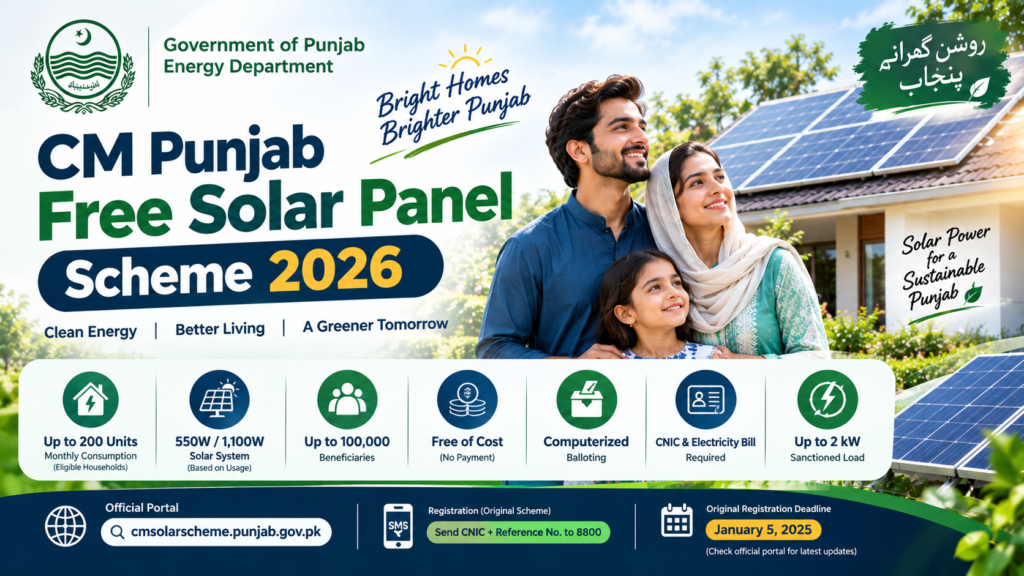
CM Punjab Free Solar Panel Scheme 2026
Electricity bills have become one of the biggest monthly expenses for many households in Pakistan. For families that use only a small amount of electricity, even a modest increase in the monthly bill can put pressure on the household budget.
To provide support to low-consumption domestic electricity consumers, the Government of Punjab launched the CM Punjab Free Solar Panel Scheme. The programme was designed to provide free solar systems to eligible households across Punjab through a computerized balloting process.
The official Punjab Portal states that the government planned to provide up to 100,000 solar systems free of cost to poor households consuming between 0 and 200 electricity units per month. The Punjab Energy Department lists the scheme with a financial outlay of approximately Rs. 9.97 billion, up to 100,000 beneficiaries, eligibility based on June 2024 electricity consumption and a sanctioned load of up to 2 kW.
The scheme has sometimes been described online as the CM Punjab Solar Scheme 2026, Free Solar Panel Scheme 2026, or even the Roshan Gharana programme. However, these names can create confusion because different solar initiatives have been announced at different times.
For anyone searching for the latest information in 2026, the most important point is this:
The original free-solar registration phase was for the scheme launched in December 2024, and the official Punjab scheme page lists January 5, 2025 as the registration deadline.
Therefore, applicants should not trust websites or social-media posts claiming that a new registration round is automatically open unless a fresh announcement appears on an official Punjab government portal.
This complete guide explains the scheme, eligibility, solar system size, registration method, balloting, verification, official portal, result checking and important precautions.
What Is the CM Punjab Free Solar Panel Scheme?
The CM Punjab Free Solar Panel Scheme is a Government of Punjab initiative aimed at helping low-consumption domestic electricity consumers shift part of their household energy use toward solar power.
Under the original scheme, households consuming up to 200 units of electricity per month could qualify, subject to the programme’s other conditions.
The government announced that:
- Up to 100,000 solar systems would be provided.
- Eligible households would receive the systems free of cost.
- Electricity consumption would be assessed using the June 2024 bill.
- The sanctioned load had to be up to 2 kW.
- Selection would take place through computerized balloting.
- Selected applicants would undergo physical verification.
- Solar panels and associated equipment would be linked with the beneficiary’s computerized CNIC information to help protect the equipment from unauthorized transfer.
The Punjab Energy Department continues to list the Free Solar Panel Scheme (0–200 Units) among its initiatives.
Is CM Punjab Solar Scheme Registration Open in 2026?
This is one of the most important questions for people searching for the scheme today.
The original official Punjab scheme page lists the registration deadline as:
January 5, 2025
Therefore, the original registration phase should not be described as an active 2026 application window.
The Punjab Energy Department’s official information confirms that the programme was based on registration through the portal and SMS 8800, followed by computerized balloting and physical verification.
This means there is an important difference between:
New Registration
Submitting a new application for the scheme.
Existing Application Status
Checking the status or result of an application that was already submitted during the registration period.
People who already applied should look for official result/status information rather than submitting a second application through an unofficial website.
If the Punjab government announces a new registration phase in the future, applicants should confirm the new deadline and criteria through the official Punjab government or Energy Department channels.
CM Punjab Free Solar Panel Scheme Eligibility
The original eligibility criteria were based primarily on household electricity consumption and the applicant’s electricity connection.
According to the official Punjab Portal and Energy Department, domestic consumers using up to 200 units per month were eligible categories for the scheme, subject to the remaining requirements.
The main criteria included:
- The applicant had to be a domestic electricity consumer.
- Electricity consumption had to fall within the eligible 0–200 unit categories.
- Eligibility was determined using the June 2024 electricity bill.
- The sanctioned electricity load had to be up to 2 kW.
- The applicant had to provide the required electricity reference number and CNIC information.
- The connection had to satisfy the programme’s verification requirements.
The scheme covered different low-consumption categories, including lifeline, protected and unprotected domestic consumers within the 0–200 unit range.
Electricity Consumption Categories
The scheme covered several electricity-consumption categories.
These included:
| Monthly Consumption | Category |
|---|---|
| Up to 50 units | Lifeline |
| 51–100 units | Lifeline |
| 0–100 units | Protected / Unprotected |
| 101–200 units | Protected / Unprotected |
The official Punjab Portal specifically states that eligibility was based on domestic consumers with monthly consumption of up to 200 units, with the June 2024 billing period used for determining eligibility.
This is important because applicants cannot simply look at their current 2026 electricity bill and assume that it determines their original eligibility.
The scheme was designed around the specified historical billing period.
Sanctioned Load Requirement
Another important condition was the sanctioned load.
The official scheme information states that consumers with a sanctioned load of up to:
2 kW
were eligible.
Sanctioned load and monthly electricity consumption are not the same thing.
For example, a household may have relatively low monthly electricity consumption but still have a sanctioned load above the scheme’s limit.
Therefore, anyone checking an old application should look at the actual electricity connection information rather than relying only on the number of units consumed.
Who Was Not Eligible?
The official Punjab Portal identified several situations that could exclude a household from the scheme.
These included:
Electricity Theft
Domestic consumers involved in electricity theft were excluded.
Defective Meter
Consumers with defective electricity meters were not eligible.
Multiple Meters at One Residence
A household with multiple electricity meters at the same residence could be excluded under the scheme rules.
Repeated Late Payments
Consumers with more than three late payments during the relevant 12-month period were excluded.
These conditions were intended to ensure that the scheme was directed toward qualifying domestic electricity consumers and that the applicant’s electricity record could be properly verified.
How Many Solar Panels Were Provided?
One of the most searched questions about the programme is the size of the free solar system.
The original Punjab government announcement explained that the system size depended on the household’s electricity consumption.
Households Using Up to 100 Units
Eligible consumers using up to 100 units were to receive a:
550-watt solar system
Households Using 101–200 Units
Eligible consumers using between 101 and 200 units were to receive a:
1,100-watt solar system
These figures refer to the solar-system capacity announced for the programme.
The exact equipment configuration and installation should be understood from the official implementation process rather than assuming that a solar panel wattage figure represents the total amount of electricity a household can use.
What Does the Free Solar System Include?
The Government of Punjab described the programme as providing solar energy systems to selected households.
The system was intended to help households generate electricity from solar energy and reduce dependence on conventional grid electricity.
Depending on the implementation and beneficiary category, the equipment may include components such as:
- Solar panels
- Inverter
- Supporting electrical equipment
- Wiring and installation-related components
Applicants should not purchase equipment from an outside seller simply because someone claims it is required for the government scheme.
The official programme determines what equipment is supplied and installed for selected beneficiaries.
How Was the Solar Scheme Selection Done?
The scheme did not operate as a simple first-come, first-served programme.
Instead, the government announced a computerized balloting system.
The basic process was:
Registration → Eligibility Screening → Computerized Balloting → Physical Verification → Installation
This is an important distinction.
Being eligible to apply did not automatically mean that every applicant would receive a solar system because the government had a fixed number of systems available.
The official Energy Department states that the scheme involved transparent computerized balloting and physical verification by the district administration.
Why Was Balloting Required?
The number of interested households was expected to be much larger than the number of available solar systems.
The government therefore used computerized balloting to select beneficiaries from eligible applications.
This means applicants should be cautious about anyone who claims:
- “I can guarantee your selection.”
- “Pay me and I will add your name.”
- “I can change your ballot result.”
- “You need to pay a processing fee to win.”
A legitimate government balloting system does not allow an unofficial agent to guarantee selection.
Physical Verification of Selected Applicants
Balloting was not necessarily the final step.
Selected applicants were subject to physical verification by the district administration.
This stage helps confirm that:
- The applicant actually resides at the stated address.
- The electricity connection exists.
- The household meets the programme requirements.
- The information submitted during registration is accurate.
- The solar equipment can be installed at the relevant location.
The Energy Department specifically identifies physical verification by the district administration as part of the scheme process.
Applicants should therefore keep their original documents and electricity records available if contacted for verification.
CM Punjab Solar Scheme Official Portal
The original official registration portal for the scheme is:
cmsolarscheme.punjab.gov.pk
The Punjab government announced this portal when the scheme opened for registration. It was also possible to register through SMS.
The official Punjab Portal specifically identifies the online portal as:
cmsolarscheme.punjab.gov.pk
and the SMS method as:
Reference Number + CNIC → 8800
For safety, applicants should always verify that they are using the official government domain.
Do not trust a website simply because its page title contains words such as:
“CM Punjab Solar Scheme.”
The domain is much more important.
How to Register for the CM Punjab Solar Scheme?
During the original registration period, applicants had two main methods.
Method 1: Online Registration
Applicants could visit:
cmsolarscheme.punjab.gov.pk
The online application required information associated with the electricity connection and applicant’s CNIC.
The information was then used for eligibility checking and balloting.
Because the original registration deadline has passed, people searching in 2026 should first check whether a new official application window has actually been announced before attempting to submit a new application.
Method 2: SMS Registration
The Punjab government also provided an SMS registration method.
Applicants could send their:
Electricity Bill Reference Number + CNIC Number
to:
8800
The Punjab Portal confirms the 8800 SMS registration channel.
Do not send your CNIC details to random mobile numbers advertised on Facebook, TikTok or WhatsApp.
The official short code is the important detail.
Documents and Information Required
Applicants should keep their electricity and identity information available.
Commonly relevant information included:
CNIC
The applicant’s computerized national identity card information.
Electricity Bill
The electricity bill provides important information such as:
- Reference number
- Consumer details
- Meter information
- Monthly units
- Sanctioned load
Mobile Number
A working mobile number is useful for receiving government communications.
Address Information
The applicant should provide accurate residential information because selected beneficiaries can be physically verified.
Remember that requirements can differ between registration, verification and installation stages.
How to Check CM Punjab Solar Scheme Result?
If you already submitted an application during the original registration period, checking the result is different from applying again.
The official solar scheme portal is the first place to check for result/status information:
cmsolarscheme.punjab.gov.pk
The applicant may need information such as the electricity bill reference number to check the application result.
Do not pay an agent to check your result.
A genuine result-checking service should not require a large payment or your banking credentials.
What Happens After Balloting?
If an applicant is selected through computerized balloting, the next important stage is verification.
The general process is:
Step 1: Application
The consumer submits information through the official registration method.
Step 2: Eligibility Check
The system checks the submitted information against the programme criteria.
Step 3: Computerized Balloting
Eligible applicants are included in the computerized selection process.
Step 4: Selection
Selected applicants are notified through the official process.
Step 5: Physical Verification
District administration verifies the household and electricity connection.
Step 6: Installation
After successful verification, the solar system can proceed toward installation.
The Energy Department officially lists computerized balloting and physical verification as components of the scheme.
Benefits of the CM Punjab Free Solar Panel Scheme
The scheme was designed to provide several potential benefits to qualifying households.
Lower Dependence on Grid Electricity
Generating some household electricity from solar power can reduce dependence on grid electricity.
Potential Bill Reduction
A functioning solar system can offset some electricity consumption, although the actual saving varies according to household usage, system output, weather and other factors.
Renewable Energy
Solar power is a renewable source of energy.
Long-Term Household Support
Unlike a temporary cash payment, a functioning solar installation can continue producing electricity over time.
Environmental Benefits
The Punjab government stated that installing 100,000 solar systems would reduce carbon emissions by approximately 57,000 tons.
Is CM Punjab Solar Scheme the Same as Roshan Gharana?
This is an area where online information can become confusing.
The names Roshan Gharana and CM Punjab Free Solar Panel Scheme have both appeared in discussions about Punjab’s solar initiatives.
However, readers should not assume that every solar programme announced by the Punjab government has identical eligibility rules.
The free scheme that officially opened for registration was specifically aimed at domestic consumers using 0–200 units, with selection through computerized balloting.
The Punjab Energy Department separately lists other renewable-energy initiatives and programmes.
Therefore, if a website says:
“Roshan Gharana registration is open for everyone”
you should verify that claim through the official Punjab government portal before submitting your CNIC.
CM Punjab Solar Scheme 2026 Latest Status
For 2026, the biggest issue is the difference between scheme continuation and new registration.
The Punjab Energy Department still lists the Free Solar Panel Scheme as an initiative and provides its original programme details.
However, the original Punjab government scheme page lists:
Registration Deadline: January 5, 2025
Therefore, an article published in 2026 should not tell readers that they can automatically submit a new application today.
Instead, people should use the official portal to:
- Check current information.
- Check existing application status where available.
- Check balloting information.
- Follow official government updates.
- Avoid fake registration links.
If a new application phase is announced, the government should publish a new official notification and updated application instructions.
Important Warning About Fake Solar Scheme Websites
The popularity of free solar panels has created opportunities for fraud.
Be especially careful with websites or social-media pages that promise:
“100% guaranteed solar panel.”
“Pay Rs. 2,000 and get selected.”
“Guaranteed balloting.”
“Send OTP to receive your solar panel.”
These are warning signs.
Government balloting cannot normally be guaranteed by a private agent.
Never share:
- ATM PIN
- Banking password
- OTP
- Internet banking login
- Credit/debit card PIN
with someone claiming to be a solar-scheme representative.
Your CNIC and electricity information should also only be submitted through an official government channel.
CM Punjab Solar Scheme FAQs
Is CM Punjab Free Solar Panel Scheme really free?
The original programme was announced as a free solar-system scheme for selected eligible households. The government planned to provide up to 100,000 systems free of cost.
Who was eligible?
Domestic electricity consumers using up to 200 units per month, subject to the programme’s other conditions, including a sanctioned load of up to 2 kW.
Which month’s electricity bill was used?
Eligibility was based on the June 2024 electricity bill.
What is the sanctioned load limit?
The official scheme information specifies a sanctioned load of up to 2 kW.
How many solar systems were planned?
The government announced up to 100,000 beneficiaries.
How were beneficiaries selected?
Through transparent computerized balloting, followed by physical verification for selected applicants.
What was the SMS code?
The registration SMS code was:
8800
What was the official website?
The official portal announced for the scheme was:
cmsolarscheme.punjab.gov.pk
Is registration open in 2026?
The original registration deadline was January 5, 2025. Do not assume that a new 2026 registration phase is open unless a fresh official announcement confirms it.
Can I apply through an agent?
There is no reason to pay an unofficial agent for ordinary government registration or result checking.
Can someone guarantee my selection?
No legitimate person should promise a guaranteed computerized-balloting result.
What if I already applied?
Use the official solar scheme portal and government channels to check the status/result of your existing application.
Final Thoughts
The CM Punjab Free Solar Panel Scheme is one of Punjab’s major household renewable-energy initiatives, particularly for low-consumption domestic electricity consumers.
The original programme targeted households using 0 to 200 electricity units per month, with eligibility linked to the June 2024 billing period and a sanctioned load of up to 2 kW. The government announced up to 100,000 free solar systems, with different system capacities depending on electricity consumption.
The programme was not simply a first-come, first-served giveaway. Applicants were registered and screened, eligible applications were entered into computerized balloting, and selected households were subject to physical verification before installation.
The official Punjab Energy Department lists the programme with a financial outlay of approximately Rs. 9.97 billion, up to 100,000 beneficiaries, portal/SMS registration, computerized balloting and district-level physical verification.
For anyone searching for CM Punjab Free Solar Panel Scheme 2026, it is particularly important to understand the difference between the original registration phase and later status or installation updates.
The original Punjab government scheme page lists January 5, 2025 as the registration deadline. Therefore, websites claiming that everyone can simply submit a new application in 2026 should be treated carefully unless they provide a current official Punjab government notification.
The official portal associated with the scheme is:
cmsolarscheme.punjab.gov.pk
The original SMS registration method was:
Electricity Reference Number + CNIC → 8800
Applicants should always verify current instructions through official Punjab government and Energy Department sources.
Most importantly, never pay someone who promises guaranteed selection, never share your OTP or banking credentials, and never enter your CNIC information into an unknown website.
For existing applicants, the official portal remains the appropriate place to look for application and result information. For future registration phases, rely on a new official announcement rather than an unofficial article or social-media post.
The Punjab government’s broader Energy Department continues to publish information about renewable-energy initiatives, including the Free Solar Panel Scheme and other solarization projects.
In short, the scheme’s main goal was to help eligible low-consumption households use solar energy while reducing their dependence on conventional electricity. For families selected through the programme, the installation of a solar system can represent a meaningful long-term change in how household electricity is produced and consumed.
Quick Information Box
Scheme: CM Punjab Free Solar Panel Scheme
Province: Punjab, Pakistan
Target Consumers: Domestic electricity consumers
Eligible Consumption: 0–200 units
Reference Billing Month: June 2024
Sanctioned Load: Up to 2 kW
Planned Beneficiaries: Up to 100,000
Up to 100 Units: 550-watt solar system
101–200 Units: 1,100-watt solar system
Selection: Computerized balloting
Verification: District administration
Original SMS Code: 8800
Original Official Portal: cmsolarscheme.punjab.gov.pk
Original Registration Deadline: January 5, 2025
Important 2026 Note: Verify any new registration announcement directly through official Punjab government channels.
Official Sources
For the most reliable information, applicants should check the Punjab Portal and Punjab Energy Department rather than relying on third-party registration websites.