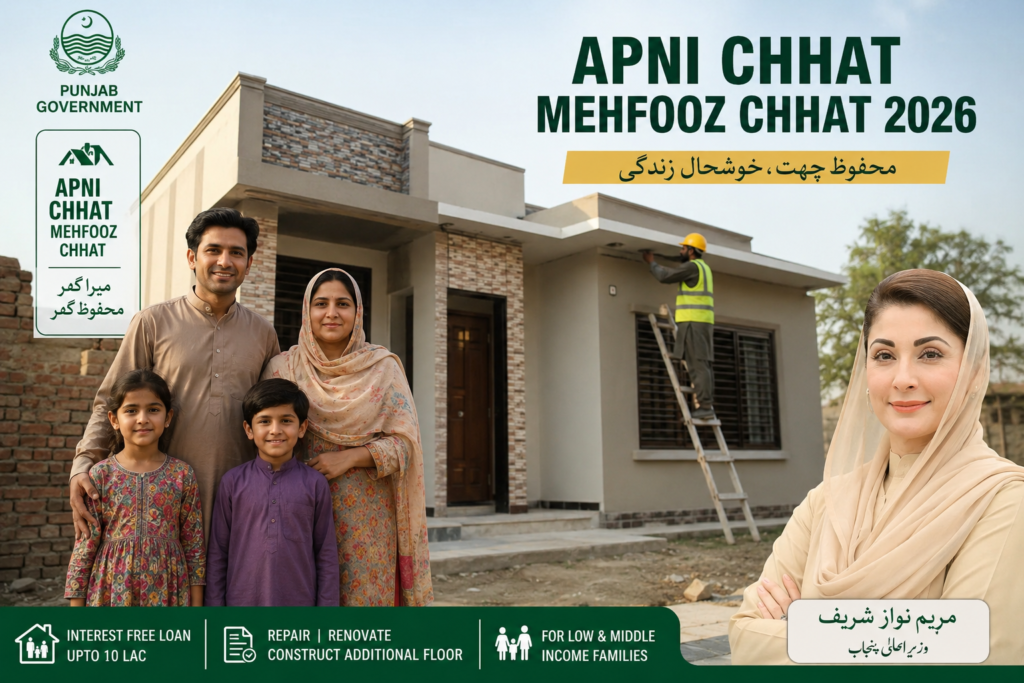
Having a roof over your head is one thing, but having a safe and strong roof is something every family deserves. For many low-income families in Punjab, repairing an old roof, strengthening weak walls, fixing structural problems, or adding another room can be financially difficult.
This is where the Apni Chhat, Mehfooz Chhat Program 2026 comes in.
The Punjab Government has introduced this housing support initiative to help families make their existing homes safer and more usable. The program focuses on people who already have a residential property but need financial assistance to repair, strengthen, renovate, or expand it.
The scheme is particularly important for families living in older houses where roofs and other structural parts may have become weak over the years. Instead of allowing families to continue living with unsafe construction, the program provides access to interest-free financing for eligible home improvement and expansion work.
According to the Punjab Government’s official information, the program includes financing of up to Rs. 500,000 for certain repair and strengthening work and up to Rs. 1,000,000 for construction of an additional storey.
For applicants, one of the most important things to understand is that this is not simply a cash assistance program. It is a housing financing initiative with eligibility requirements, verification, repayment conditions, and an official application process.
In this guide, we explain Apni Chhat Mehfooz Chhat 2026 in simple language, including what the program is, who may qualify, how much financing is available, what the money can be used for, how to apply online, what documents may be required, and where to find official government information.
What Is Apni Chhat Mehfooz Chhat?
Apni Chhat, Mehfooz Chhat, which can be translated as “My Roof, Safe Roof,” is a Punjab Government housing initiative designed to help eligible homeowners improve the safety and usability of their existing homes.
The program is different from a traditional housing scheme where a person receives a new house or a plot. Its focus is on existing residential properties that need improvement or expansion.
For example, imagine a family living in a house where the roof has developed cracks, water leaks through during heavy rain, or the structure has become old and weak. The family may know that repairs are necessary but may not have enough savings to pay for major construction work.
Similarly, a family may have a stable house but need additional living space because children have grown up or more family members are living together.
The Apni Chhat Mehfooz Chhat initiative is intended to address these kinds of housing needs.
The Punjab Government’s official project information identifies two broad financing categories:
- Financing of up to Rs. 500,000 for home repair and strengthening-related work
- Financing of up to Rs. 1,000,000 for construction of an additional storey
The official Punjab Portal lists repayment tenures of up to 3 years for the first category and up to 6 years for the additional-storey category.
The project was launched in July 2026. Its introduction followed concerns about unsafe residential structures and the dangers faced by families living under weak roofs. Reporting by Dawn said the initiative was launched following a roof-collapse tragedy in Kahna in which 14 children lost their lives.
That background helps explain the central idea behind the program: a home should not only be affordable; it should also be structurally safe.
Why Is a Safe Roof So Important?
For an ordinary family, the roof is often something they only think about when there is a problem.
During normal weather, an old roof may appear perfectly fine. But heavy rain, strong winds, water accumulation, poor construction, cracks, corrosion, or years of neglect can turn structural weaknesses into serious safety hazards.
A leaking roof can also create other problems.
Water may damage ceilings, electrical wiring, walls, furniture, and household belongings. Continuous moisture can contribute to deterioration of building materials. In severe situations, structural weakness can become a danger to everyone inside the home.
This is why repairing a roof should not always be treated as a cosmetic renovation.
A family might postpone repairs because the cost seems too high. The problem then becomes worse, and the eventual repair may become even more expensive.
A government-backed interest-free financing option can therefore be useful for families who have a property but lack sufficient cash for urgent construction work.
The purpose of Apni Chhat Mehfooz Chhat is essentially built around this idea: help families make the homes they already have safer.
Apni Chhat Mehfooz Chhat Loan Amount 2026
One of the most common questions people ask is:
“How much loan can I get under Apni Chhat Mehfooz Chhat?”
The answer depends on the type of work you intend to undertake.
Category 1: Repair, Strengthening and Additional Room
The first category provides financing of up to:
Rs. 500,000 (5 lakh)
This category is intended for eligible home improvement work, including repair and strengthening of weak or dilapidated roofs and certain additional-room construction.
The official Punjab Portal lists a repayment tenure of up to 3 years for this financing category.
This option may be relevant for families whose biggest problem is the condition of their current home.
For example, eligible construction work could involve:
- Repairing a weak roof
- Strengthening damaged sections
- Renovating deteriorated parts of the house
- Addressing serious roof-related problems
- Adding an additional room where permitted under the program
Applicants should remember that the exact work permitted and amount approved depends on official assessment and program rules. A person should not assume that every type of renovation automatically qualifies.
Category 2: Additional Storey
The second category provides financing of up to:
Rs. 1,000,000 (10 lakh)
This option is intended for construction of an additional storey or floor.
The official Punjab Portal lists a repayment tenure of up to 6 years for this category.
This could be particularly useful for families who already own a house but have limited living space.
Instead of purchasing a larger property, a qualifying homeowner may be able to use the financing to construct another floor, subject to the applicable requirements, verification, and construction rules.
Is Apni Chhat Mehfooz Chhat Interest-Free?
Yes, the program is presented as an interest-free financing facility.
This is one of the major reasons the scheme has attracted attention among families looking for affordable housing assistance.
However, applicants should understand the difference between an interest-free government financing program and a grant.
Interest-free does not necessarily mean free money.
If financing is approved, the applicant is generally expected to repay the principal according to the applicable repayment schedule.
Therefore, anyone applying should carefully understand:
- The approved amount
- The repayment period
- The monthly installment
- Any applicable conditions
- The construction requirements
- Verification requirements
- The consequences of late or missed payments
The official Punjab Government portal should always be treated as the final authority if repayment terms or eligibility rules are updated.
Who Can Apply for Apni Chhat Mehfooz Chhat?
Eligibility is one of the most important parts of the program.
Because this is a government-supported housing initiative, applicants cannot simply apply for money without meeting the relevant conditions.
Current information about the program indicates that applicants need to meet property, residency, financial, and verification requirements.
A key requirement is that the applicant should have a qualifying residential property in Punjab.
Current reporting on the program says applicants must be permanent residents of Punjab and hold a valid CNIC. It also reports property-size requirements of up to 5 marlas in urban areas and up to 10 marlas in rural areas.
However, applicants should always check the official portal before submitting an application because government schemes can change their requirements, categories, and documentation.
Basic Eligibility Points
Depending on the applicable category and current official rules, an applicant may need to satisfy requirements such as:
- Being a permanent resident of Punjab
- Having a valid CNIC
- Owning and possessing the qualifying residential property
- Meeting the applicable plot/property size requirement
- Having valid property ownership records
- Passing government verification
- Meeting applicable financial conditions
- Not being a loan defaulter where this condition applies
- Providing accurate information and documentation
The program information reported by ARY News also mentions verification through NADRA and the Punjab Land Records Authority (PLRA).
This is important because applicants should make sure their identity and property records are properly updated before applying.
Property Size Requirement
Property size is an important factor.
Current program information reports a maximum property size of:
- Up to 5 marlas in urban areas
- Up to 10 marlas in rural areas
The purpose of setting property limits is to keep the program focused on families and homes within the target category.
If you are unsure whether your property falls within the applicable urban or rural classification, do not rely on a social media post or an unofficial website.
Check the official ACAG portal or contact the relevant government facilitation office.
Property records should also be clear and verifiable.
If there is a dispute regarding ownership, incomplete mutation information, incorrect records, or another legal issue, the application may require additional verification.
What Documents May Be Required?
Before applying, it is sensible to prepare your documents.
Current reporting about the program states that applicants may need to provide documents such as:
- CNIC
- Proof of property ownership
- Fard or relevant land record
- Photographs of the existing house
- Other information required for verification
ARY News specifically reported that applicants applying through the ACAG portal may be asked to upload their CNIC, proof of property ownership (Fard), and photographs of the existing house.
Keep original documents safely available because online submission does not necessarily eliminate the possibility of physical verification.
Prepare Your CNIC
Your CNIC should be valid and your information should match the official records.
If there is a spelling difference in your name, an outdated address, or another discrepancy, resolving it before applying can help avoid unnecessary delays.
Prepare Property Documents
Property ownership is especially important for a housing-related financing program.
Keep relevant documents such as:
- Fard
- Registry
- Mutation/Intiqal
- Other applicable ownership documents
The exact document requirements should be confirmed from the official application portal.
Take Clear Property Photographs
If photographs are requested, take clear images showing the actual condition of the house.
Avoid uploading blurry, dark, edited, or unrelated photographs.
If the purpose is roof repair, photographs should clearly show the condition that requires attention.
How to Apply for Apni Chhat Mehfooz Chhat Online
The online application process is connected with the Apni Chhat Apna Ghar (ACAG) government portal.
The official portal is:
Apni Chhat Apna Ghar — Official Punjab Government Portal
This is an important point because many unofficial websites use names similar to government schemes.
Applicants should avoid entering CNIC information or other personal details on random websites.
Step 1: Visit the Official Portal
Open the official ACAG website.
The Punjab Government’s portal identifies the platform as the Apni Chhat Apna Ghar Program and provides the official housing-program interface.
Step 2: Create or Access Your Account
Follow the registration/login instructions available on the official portal.
Use your own valid information.
Do not use somebody else’s CNIC, mobile number, or property information.
Step 3: Select the Relevant Financing Category
Applicants should carefully select the financing option that matches their intended construction work.
The program provides different categories, including:
Partial financing for repair/strengthening and additional room
and
Financing for construction of an additional storey.
The official Punjab Portal lists the maximum financing and repayment tenure for these categories.
Step 4: Enter Property Information
Provide the requested property information accurately.
This can include:
- Property location
- Plot size
- Ownership information
- Existing structure information
- Type of proposed construction
Do not guess important property details.
If your Fard or registry shows information different from what you enter, verification could become difficult.
Step 5: Upload Required Documents
Upload clear copies of the documents requested by the portal.
Make sure:
- CNIC images are readable
- Property documents are clear
- Photographs are relevant
- Files are uploaded in the requested format
- Names and information match
Step 6: Submit the Application
Before clicking submit, carefully review your application.
A small mistake in your CNIC, property information, mobile number, or ownership details can create problems later.
Save your application/reference number after submission.
Step 7: Wait for Verification
After submission, the application may go through different verification stages.
Government systems can verify identity, property ownership, and other eligibility information.
The official ACAG website also provides an Applicant Status page where application information and status can be displayed.
Can You Apply Offline?
Online applications are not necessarily the only way to seek assistance.
Current reporting says facilitation/help desks have been established through government offices, including offices of Deputy Commissioners and Assistant Commissioners, as well as relevant PHATA offices.
This is particularly useful for people who:
- Do not have reliable internet
- Are not comfortable using online forms
- Need help understanding the application
- Have difficulty uploading documents
If you need assistance, contact the official government offices rather than paying an unofficial agent.
What Is PHATA?
You may see the name PHATA frequently while researching Punjab housing schemes.
PHATA stands for Punjab Housing and Town Planning Agency.
It is a provincial housing agency involved in housing development and low-cost housing initiatives.
Government information describes PHATA’s role as including affordable and low-cost housing, assistance to local governments, and implementation of housing programs in Punjab.
For housing applicants, this means PHATA is an important official organization to understand when dealing with Punjab Government housing initiatives.
Apni Chhat Mehfooz Chhat vs Apni Chhat Apna Ghar
These two names can easily confuse people.
They are related, but they serve different housing needs.
Apni Chhat Apna Ghar
The Apni Chhat Apna Ghar program is a broader Punjab Government housing initiative focused on affordable housing and helping eligible families build or obtain homes.
The Punjab Government says the program aims to provide 100,000 affordable houses/apartments to eligible families.
The program has also provided interest-free financing to qualifying plot owners for home construction.
Apni Chhat Mehfooz Chhat
The newer Apni Chhat, Mehfooz Chhat project focuses on making existing homes safer and providing financing for repairs, strengthening, and additional construction.
The official project information lists up to Rs. 500,000 for the first category and up to Rs. 1,000,000 for an additional storey.
In simple words:
Apni Chhat Apna Ghar = help with building/obtaining a home
Apni Chhat Mehfooz Chhat = help with making an existing home safer or expanding it
This distinction can help applicants choose the correct program.
How Much Is the Monthly Installment?
The monthly installment depends on the amount borrowed and the applicable repayment period.
The official Punjab Portal currently lists:
Category 1: Up to Rs. 500,000 with repayment tenure of up to 3 years.
Category 2: Up to Rs. 1,000,000 with repayment tenure of up to 6 years.
Because government programs can revise repayment arrangements, applicants should not rely solely on figures shared by blogs, YouTube videos, TikTok posts, or Facebook pages.
Before accepting financing, check the repayment schedule shown by the official system.
For example, simply dividing the maximum loan by the number of months gives only a rough mathematical estimate. The actual repayment structure can depend on the approved amount, category, and official terms.
Therefore, always confirm the final installment from your official approval documents.
Is There a Processing Fee?
According to reporting on the launch, the Punjab Government would bear the processing fee and other associated charges for the loans.
This is another reason applicants should be careful about people who claim they can “guarantee” approval in exchange for large fees.
A genuine government application should be completed through official channels.
If someone contacts you through WhatsApp or Facebook and asks for money to “confirm your loan,” verify the request with the official government helpline or portal before paying anything.
How to Avoid Scams
Whenever a government scheme becomes popular, unofficial websites and social media pages often appear.
Some may provide useful information, but others may attempt to collect personal data or money.
Follow these safety rules:
1. Use the Official Portal
Use the official ACAG website:
2. Never Share Your OTP
Never give your OTP to an unknown person.
A person claiming to be an “agent” does not need your OTP simply to help you understand a government application.
3. Do Not Pay for Guaranteed Approval
Nobody should be able to guarantee that your application will be approved.
Approval depends on eligibility, verification, available program rules, and the government’s decision.
4. Verify Helpline Numbers
The official ACAG portal displays the toll-free number 0800-09100.
The portal’s contact section also lists PHATA contact numbers 042-99213419 and 042-99213428, along with the PHATA email address.
Before calling a number found on social media, compare it with the official government website.
What If Your Property Documents Are Not Updated?
This is a common issue for homeowners.
A family may have lived in a house for decades, but its official ownership records may not be completely updated.
For example, property may have been inherited but mutation was never completed.
In such cases, applicants should not simply upload whatever old document they have and hope for approval.
Instead, first determine what ownership record is required and whether the property record needs correction or updating.
The Punjab Government’s land-record systems and relevant offices can help with property-related documentation.
Because housing applications can involve property verification, keeping your land records organized is one of the smartest steps you can take before applying.
What Construction Work Should You Prioritize?
If you receive financing for roof repair or strengthening, focus first on safety rather than decoration.
For example, a family should prioritize:
- Structural roof problems
- Serious cracks
- Water leakage
- Weak supporting areas
- Damaged construction
- Unsafe sections of the house
Cosmetic improvements such as expensive decorative tiles or luxury finishes should not take priority over structural safety.
If you are constructing another floor, consult a qualified engineer or building professional before starting construction.
An existing house may have been designed only for its current load. Adding another floor without proper structural assessment can be dangerous.
A government loan can provide financial support, but engineering safety should always come first.
Why Structural Inspection Matters
Many homeowners think that if a building has survived for years, it must be safe.
That is not necessarily true.
Buildings age.
Concrete, steel, masonry, waterproofing, and other components can deteriorate over time. Water penetration can worsen structural problems. Changes made to a house over the years can also affect its stability.
If you plan to add a floor, an engineer should assess whether the existing structure can safely carry the additional load.
This is especially important in older houses.
The objective of Apni Chhat Mehfooz Chhat is not simply to give families money for construction. The larger objective is to help create safer homes.
Important Tips Before Applying
Before submitting your application, take a few minutes to prepare.
Check Your CNIC
Make sure your CNIC is valid and your personal information is correct.
Check Property Ownership
Confirm that your property ownership documents are available and readable.
Measure Your Property Correctly
Make sure you know the official size of your property and whether it falls within the applicable urban or rural limit.
Take Proper Photos
If photographs are required, take clear photos of the actual property and the areas requiring work.
Choose the Correct Category
Do not select the additional-storey category if your actual requirement is only roof repair.
Similarly, do not select a repair category if your main purpose is construction of an additional floor.
Keep Your Application Number
After submission, save screenshots or write down your application/reference number.
You may need it when checking your application status.
How to Check Application Status
The official ACAG portal provides an applicant-status facility.
The status page includes fields such as:
- Application ID
- Applicant name
- CNIC
- Application status
- Selected organization/MFI information where applicable
You can access the official portal here:
Check the Official ACAG Portal
Always use the official website when checking sensitive application information.
Other Real Punjab Government Schemes and Official Portals
Apni Chhat Mehfooz Chhat is not the only government initiative available to Punjab residents.
The Punjab Government operates several programs for housing, social assistance, agriculture, energy, business, and other needs.
However, eligibility differs from scheme to scheme.
Apni Chhat Apna Ghar
This is the main Punjab Government affordable housing initiative associated with the ACAG portal.
Official Apni Chhat Apna Ghar Portal
The Punjab Government describes the initiative as a program aimed at providing affordable houses/apartments to eligible families.
Punjab Government Portal
The official Punjab Government portal is another useful starting point for checking government programs and announcements.
Punjab Government Official Portal
Punjab Dastak
Maryam Ki Dastak is Punjab’s one-window platform for accessing government services online and, for certain services, through doorstep facilitation.
Maryam Ki Dastak Official Portal
The platform describes itself as an online one-window service for Punjab Government services.
Punjab Social and Other Welfare Services
People looking for government assistance should also check the official Punjab departments rather than relying on unofficial “registration” websites.
For example, Punjab’s Zakat & Ushr Department provides information about programs such as the CM Punjab Rahmat Card, with its own official portal and helpline.
The important lesson is simple:
Always verify a scheme through a government domain before sharing your CNIC or personal information.
Frequently Asked Questions
What is Apni Chhat Mehfooz Chhat?
Apni Chhat, Mehfooz Chhat is a Punjab Government housing initiative designed to provide interest-free financing for eligible homeowners who need to repair, strengthen, or expand their existing homes.
How much loan is available?
The official Punjab Portal lists financing of up to Rs. 500,000 for the first category and up to Rs. 1,000,000 for construction of an additional storey.
Is the loan interest-free?
Yes. The program is designed as interest-free financing for eligible applicants.
How long is the repayment period?
The official project information lists up to 3 years for the Rs. 500,000 category and up to 6 years for the additional-storey category.
Can I use the financing to repair my roof?
The first category specifically covers repair and strengthening of weak or dilapidated roofs, subject to the applicable eligibility and approval conditions.
Can I build another floor?
Yes, the second category is designed for construction of an additional storey, with financing of up to Rs. 1 million according to the official Punjab Portal.
Where can I apply?
The official ACAG portal is:
What documents do I need?
Current reporting indicates that applicants may need a valid CNIC, proof of property ownership such as Fard, and photographs of the existing house, along with other information requested during the application process.
Can someone guarantee my approval?
No legitimate person should guarantee government approval.
Your application must pass the relevant eligibility and verification process.
Is Apni Chhat Mehfooz Chhat the same as Apni Chhat Apna Ghar?
No. They are related Punjab Government housing initiatives but have different purposes.
Apni Chhat Apna Ghar is a broader affordable housing program, while Apni Chhat Mehfooz Chhat focuses on improving the safety and capacity of existing homes.
Final Thoughts
For a family living in an old or overcrowded house, finding money for major construction can be extremely difficult.
A damaged roof cannot always wait until a family has enough savings. Likewise, a growing family may need additional living space but may not have the financial ability to purchase a new house.
The Apni Chhat, Mehfooz Chhat Program 2026 attempts to address these practical problems by providing interest-free financing for eligible home improvement and expansion projects.
The official Punjab Government project provides up to Rs. 500,000 for the first financing category and up to Rs. 1,000,000 for construction of an additional storey. The listed repayment periods are up to three years and six years respectively.
But applicants should not rush into the process based on social media claims.
The safest approach is to:
- Check the official eligibility requirements.
- Keep your CNIC and property documents ready.
- Make sure your ownership information is accurate.
- Use the official ACAG portal.
- Select the correct financing category.
- Submit truthful information.
- Keep your application/reference number.
- Follow official verification procedures.
- Confirm the final repayment schedule before accepting financing.
- Avoid agents who promise guaranteed approval.
Most importantly, if you are planning to add another floor, do not focus only on the loan amount. Make structural safety the first priority.
A house is not truly a home if the people living inside it are worried about whether the roof or walls are safe.
That is why the idea behind Apni Chhat, Mehfooz Chhat is important: helping families move from simply having a roof over their heads to having a roof they can trust.
For the latest eligibility rules, application instructions, and status information, always use the official Punjab Government and ACAG sources because program conditions can change over time.
Official ACAG Portal: acag.punjab.gov.pk
Official Punjab Government Portal: punjab.gov.pk